Tomorrow I head off for the joint OER12/OCWC conference at Cambridge. I am looking forward to hearing a mix of views on what it will take to continue and build the momentum of the OER movement. OpenEd 2011 was a fabulous event and as someone based in the UK it drew my attention to a new perspective on open education, particularly away from HE and into schools. There has been heartening news over recent weeks of regional and sector push towards openness, including in US schools as a result of pioneering work by David Wiley and others and the announcement last week from the World Bank about research.Next week's conference promises to offer an international mix of experiences to mine and learn from.
My own session is a short demo called 'Cartoons and Card Tricks'.
At OER11 I unleashed v.1 of the reuse cards and its been
great to hear how people have used these cards in the past year as a medium for
exchanging views with novices to OER, to open up discussion and
hopefully open eyes to the potential of sharing and using OER. The cards have travelled from seminar rooms and conferences to less formal venues - bars and dinner parties. They recently did a little detour to EUROCALL in Italy last month with Anna Comas-Quinn. Feel free to reuse, translate and adapt the cards yourself. The idea of reusing cards about reuse must make sense. I've spruced them up for OER12 and spring-cleaned the shop (see link above) a little.
One of the resources added is a new cartoon from Steve Davies, formulated as a worksheet but adaptable as you wish. It looks at the axis between promise and practice in OER activity. This one of the ideas behind the ORIOLE project. Practitioners have a lot to learn about the promise of OER, if they can find the time to look around. However those looking to the future, to the promise of OER and increasingly open landscapes, or trying to formulate policy based on this new future, can learn from noting what practitioners need, what they use, and how they use it.This latest cartoon asks you to consider what your perspective is, promise- or practice-heavy, light, or balanced. Perhaps we need more emphasis on promise at this stage to capture the imagination, but if so when does the balance need to shift? The cards and the cartoons are trying to test how this might be achieved as gaining ground in the hearts and heads of practitioners becomes important to maintain the movement that we are all engaged in.
Sunday, 15 April 2012
Wednesday, 7 March 2012
Open Education Week (March 5-10 and all year round)
5-10 March 2012 is the very first Open Education week. A great idea and the Open Education Week website list of webinars and events offers an amazing, exciting, heart-warming menu of happenings to celebrate and draw attention to what Open Education is. There is certainly a lot of open education going on. [Pause for thought].
There has been lots going on in the run up to open education week, interesting announcements about success in securing OER K-12 legislation in Washington State, OERu activity, a very visual cc-by licensed UNESCO-initiated logo for OER that works in countries where the words 'open education resources' don't mean the same as we think they mean (translations here). All evidence of hard work by lots of people over a long period. [Pause for applause well earned].
There will be lots of open education going on AFTER open education week. [Hooray!] Looking at the list of webinars. There will be one starting shortly, (featuring Patrick McAndrew, Martin Weller and Sandra Wills and organised by University of Leicester's TOUCAN project (I will be there) which will link to archived recording as well as being live.
The great thing about Open Education week is that it draws attention to the great openness that is happening all the time and all around. There will be sharing beyond this week. The resources, ideas and initiatives shared now will be used and referred to in the future by people who don't yet know what open education is all about. That is the great thing about open ed. Its out there, its in the air. Definitely something to celebrate and spread the word about. Perhaps think of what you can do this week that would be special and new for you (or someone else). Tell someone about open education who really does not have a clue. Sign up for a commitment to carry on with open ed after this week (SCORE has a nice simple resolution, and the OER Cape Town Declaration cannot fail to inspire).
A slogan comes to mind here that will be familiar to people in the UK: 'A dog is for life and not just for Christmas'. Well, open education is for life, beyond this week and beyond the people who are engaging in it this week. Open education is for life.
Tuesday, 10 January 2012
Happy New Year and thanks (again) for help with the survey
Happy New Year (this was supposed to be an end of year round up message but you know how these things go. ORIOLE plans to be a tad more lively in the next few months and I hope to catch up with people face-to-face at the OCWC/OER11 conference in Cambridge (UK) in March. I'll be demonstrating some of the outputs from ORIOLE there and have just been co-opted with Tim Seal (SCORE) to help plan a post-conference event at the OU on the 19th (i.e. the following day). So if you are planning to go to Cambridge and have the following day free put in a tentative visit to the OU in Milton Keynes (transport will be laid on). Further details will follow shortly.
So much happening in the world of Open Resources and I hope to get more information pushed out from the ORIOLE survey over the next few months. I'll be working on this with SCORE fellows Joanna Wild (Oxford University) and Ming Nie (University of Leicester). Now that we have a (mostly) full set of this we can also disperse the donations to the survey participants' three most nominated charities. These were
These each receive a £100 donation. Thanks for helping that to happen.
So much happening in the world of Open Resources and I hope to get more information pushed out from the ORIOLE survey over the next few months. I'll be working on this with SCORE fellows Joanna Wild (Oxford University) and Ming Nie (University of Leicester). Now that we have a (mostly) full set of this we can also disperse the donations to the survey participants' three most nominated charities. These were
Cancer Research UK Registered Charity No1089464 http://www.cancerresearchuk.org/ | |
| Macmillan Cancer Support Registered Charity No261017 http://www.macmillan.org.uk/ | |
| Médecins Sans Frontières (Doctors Without Borders) Registered Charity No261017 http://www.msf.org.uk/ |
These each receive a £100 donation. Thanks for helping that to happen.
Saturday, 10 December 2011
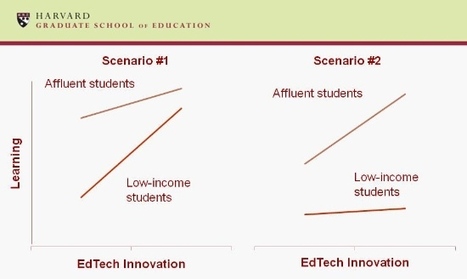
Does OER benefit affluent students more than it benefits poorer ones?
There is an interest post on the Harvard site with an eye-catching set of graphs which suggest that OER could be having a different effect to that which we expect. Note that this is a debate series so I am sure it is deliberately contentious! [Read that post]
I was thwarted by the Harvard system which only allows short comments (3 * twitter post size) without warning you that you will have to chunk down your essay :-) So after posting two parts to the start of my comment the system there decided not to talk to me. So here is my response. Comments here - or there - would be welcome. This is very much about the influence of OER, so on topic for ORIOLE. (My full comment on these graphs and the Harvard abstract follow ...)
An interesting argument to open up here. But wondering how you expect (and why you expect) Scenario #2 to happen as you draw it when your example is ready-to-use OER as opposed to wikis (which require considerable on-going resource from educators if they are to be hosted locally). I accept that well-resourced learners are well resourced so could make more use of OER should they choose to do so, and the same for their teachers. However these students already have many competing demands for their attention in terms of learning options. The well-resourced teachers in scenario #2 would have to be willing to change their teaching (which is already at a high level in your example) to reuse someone else's resources. There is no evidence that reuse will happen at a high, transformational, level in this case. Resource reuse is most likely to happen where there is a gap in the provision, or the offered resource is significantly better than what it replaces. Forgetting OER for a moment, we know this about reusable learning objects, and the behaviour of well-resourced educators with relation to these. They repurposed the resources, or made their own versions, or (most often) preferred their own versions but took new ideas or assets from the RLOs. This was part of what they did in refreshing their teaching, so it was not a huge change, just a boost.
You are also ignoring the opportunity that parents and carers can now direct poorer students to OER. One of the reasons that affluent children do better in school is because of the support of learning at home. For poorer students, where parents may not be well-educated, the great thing about OER is that these are OPEN. Not just the schools can get access. Not only registered students. I wonder at this point how open the wikis you refer to were?
This is an important discussion, it addresses over-hype and perhaps unrealistic expectation of OER (although you are sticking with the developed world here and there is another story to tell globally). However I think that your graphs overstate the case and I am struggling with the comparison of what happens with intra-institutional wikis (if that was what you were looking at) being an indicator for what will happen with OER. I'd suggest a scenario #3 with both rising to some extent but not too much for those who already have good learning resources. After all, access to online all the time via a flashy iPad. smartphone, etc. will not only be used to access education. There is quite a competition for attention going on there from Facebook, YouTube (not the formal educational stuff), etc.
Thanks for raising this.
Monday, 5 December 2011
Sharing - a cartoon to stimulate discussion
We created some nifty resources for the ORIOLE retreat back in June and are in the process of creating others from it so keep an eye on the SHOP (all free and open).
This image (click to download/view a larger version) was drawn by Steve Davies and arose from ideas I had about problems people may have in bringing themselves to share resources which they have created. The focus here is on those resources which are not that 'mature', haven't been shown around much, are perhaps unfinished, or work-in-progress. If the user is hoping to build from ideas rather than use 'as is' then sharing work which is not-pristine-but-has-promise can be helpful.
What this cartoon tries to get across is that academics and developers are pretty prolific people. We might feel protective about our work, but can't personally nurse along every good idea, or every promising start that we generate. If we put them aside in a filing drawer 'for later' when we have time to develop them, that may never happen.
So this cartoon can be used to trigger discussion about sharing 'babies' as OER as well as the fully maure work. Yes, it does sound scary, but perhaps worth considering? If you want to think scary then what happens to all those babies (ideas) left to languish in the filing cabinet ...
Chris
This image (click to download/view a larger version) was drawn by Steve Davies and arose from ideas I had about problems people may have in bringing themselves to share resources which they have created. The focus here is on those resources which are not that 'mature', haven't been shown around much, are perhaps unfinished, or work-in-progress. If the user is hoping to build from ideas rather than use 'as is' then sharing work which is not-pristine-but-has-promise can be helpful.
What this cartoon tries to get across is that academics and developers are pretty prolific people. We might feel protective about our work, but can't personally nurse along every good idea, or every promising start that we generate. If we put them aside in a filing drawer 'for later' when we have time to develop them, that may never happen.
So this cartoon can be used to trigger discussion about sharing 'babies' as OER as well as the fully maure work. Yes, it does sound scary, but perhaps worth considering? If you want to think scary then what happens to all those babies (ideas) left to languish in the filing cabinet ...
Chris
Wednesday, 26 October 2011
Assisting in the search for OER evidence
The need to locate and evaluate evidence around OER has been a consistent theme at this week's Open Ed 2011 conference in Utah. It was identified at the top of the top 3 noted by Josh Jarrett in his keynote this morning. Let me now plug the Evidence Hub which is in the early stages of playing its role, but is already gathering useful information on OER claims and identifying a wide range of evidence in support of potential solutions to the OER challenges.
Some useful links ...
- YouTube video of how it works (complete beginner's guide) - also above
- A step by step guide to getting in, adding your project, learning about the challenges, claims and most important, how to contribute evidence
- In the run up to Open Ed 2011 ten main challenges facing OER, identified from the information already identified
Tuesday, 20 September 2011
New reports on reuse and UK HE (and OER)
Reuse has often been portrayed as a Holy Grail in terms of sustainable elearning. It is also something that academics already do, when we quote and attribute we are reusing and acknolwdeging reuse. So when we are talking about reuse and open resources we may include this regular reuse but we are also talking about reusing digital resources, reused as a result of online delivery to educator(s) and/or learner(s). What the open license aspect adds is still emerging and all this activity is part of what is still a new approach to teaching.
It is great news that there are reports emerging from the Impact of OER study funded by JISC and led by teams at University of Oxford. There is lots of food for thought and discussion in these so check out
White and Manson, The value of Reuse in Higher Education
It is great news that there are reports emerging from the Impact of OER study funded by JISC and led by teams at University of Oxford. There is lots of food for thought and discussion in these so check out
White and Manson, The value of Reuse in Higher Education
Subscribe to:
Posts (Atom)